
|
Pesticides are a serious concern for
farmworkers, especially kids, due to lack of training and access to
health care. To comprehensively address pesticide
issues, Farmworker Justice advocates for policy change at the state
and federal levels; conducts pesticide litigation; issues reports
and develops and implements educational programs aimed at health
professionals, lay health educators (promotores de salud),
and policy makers.
NEW! FJ
wins Pesticide Research Program in 2008 Farm Bill!
Pesticide Hazards
and Incident Data
Pesticides pose
risks of short- and long- term illness to farmworkers and their
families. Workers who mix, load or apply pesticides (known as
pesticide handlers) can be exposed to toxic pesticides due to
spills, splashes, defective, missing or inadequate protective
equipment, direct spray, or drift. Workers who perform hand labor
tasks in areas that have been treated with pesticides face exposure
from direct spray, drift or contact with pesticide residues on the
crop or soil. Farmworker families can also be injured by pesticide
when farmworker children play in treated fields, when workers
inadvertently “take home” pesticide residues on their hair, skin or
clothing or when pesticides drift onto outdoor play areas and get
tracked into homes, etc.
The exact number of
workers injured each year by pesticides is unknown because there is
no national incident reporting system. The U.S. Environmental
Protection Agency estimates that 10,000-20,000 farmworkers are
poisoned on the job due to pesticide exposure. (EPA, Worker
Protection Standard, Economic Impact Analysis 1993). The U.S. Bureau
of Labor Statistics finds that farmworkers suffer the highest rate
of chemical-related illness of any occupational group: 5.5 per
1,000 workers. (52 Fed. Reg. 16050, 1987)
Several states,
e.g., California
and Washington State, have state incident reporting systems. In California,
in 2004, there were a total of 1,238 cases reported of which 828
were found to be possibly, probably or definitely related to
pesticides. Of those 828 cases, 390 (47%) involved agricultural
workers.
It is widely
recognized that pesticide incidents are underreported for numerous
reasons. First, many farmworkers do not seek – or cannot --medical
attention for mild to moderate symptoms because of cost, lack of
transportation, reluctance to take time off work, etc. Even when
they seek treatment, my cases of pesticide-related illness are not
recognized because the symptoms are common to many ailments (e.g.,
nausea, vomiting, dizziness, headache, skin rashes and eye
irritation). Even cases that are correctly diagnosed are often not
reported.
Recognizing
pesticide-related illness is also difficult because there are few,
inexpensive, widely available clinical diagnostic tests for
identifying acute pesticide poisoning and workers usually do not
know the name of the chemical to which they were exposed. For
health care providers, taking an occupational health history can be
helpful in identifying these cases. In addition, health providers
have a federal right to contact the employer and obtain the name of
the pesticide and the information on the circumstances of exposure.
(For information on clinical competencies for identifying
pesticide-related illness, see National Environmental
Education and Training Foundation 2000).
In 2005,
Farmworker Justice and three other groups released “Messages
from Monitoring,” a report on the results of medical monitoring
of
Washington State farmworkers' exposures to pesticides. An executive
summary of this report is also available in
Spanish.
In 2006, we
released a new report, “More
Messages from Monitoring,” on the second year of the medical
monitoring. An executive summary of this report is also available
in
Spanish. Click here for a news release about the 2006 report in
English or in
Spanish.
Chronic Effects of
Pesticide Exposure
Even low levels
of pesticide exposure over time can lead to chronic health effects
such as cancer, infertility, birth defects or neurological damage.
One study compared cancer rates among members and retirees of the
United Farm Workers of America (UFW) to those of other Latinos
living in California. (Mills, P, Cancer Incidence in the United
Farmworkers of America 1987-1997, Am J. of Ind. Med. 40:596-603,
2001). The researchers found elevated rates of: certain cancers
among the farmworkers. They included: a 59% higher rate of leukemia
(OR: 1.59); a 69% higher rate of stomach cancer (OR: 1.69); a 63%
higher rate of uterine/cervix cancer (OR: 1.63); a 68% higher rate
of uterine corpus cancer (OR: 1.68); and a 57% higher rate of brain
cancer (OR: 1.57). “Occupational exposure, particularly to
pesticides may explain the elevated risk of leukemia and brain
cancer. (p. 600).”
A study was
undertaken to compare rates of birth defects among offspring of
pesticide applicators as compared to those of infants of city
dwellers. Researchers examined 210,000 live births in Minnesota and
found that the offspring of pesticide applicators had a birth defect
rate of 30 per 100,000 live births, whereas residents of the Twin
Cities had a birth defects rate of 18.3 per 100,000 live births.
(Vincent (F. Gerry and Mary Harkin, “Pesticide Appliers, Biocides
and Birth Defects in Rural Minnesota,” Environmental Health
Perspectives, April 1996).
FIFRA and the Worker
Protection Standard
Occupational
exposure to pesticides is governed by the Federal Insecticide
Fungicide and Rodenticide Act and a set of regulations called the
Worker Protection Standard.
FIFRA requires that
pesticides sold or distributed in the United States be registered by
the EPA. Under this statute, the EPA can only register a pesticide
if it determines that the pesticide, when used in accordance with
its label, will not cause unreasonable adverse effects to human
health or the environment, taking into account the risks and
benefits to the agricultural economy. To secure an EPA
registration, pesticide manufacturers conduct a series of tests on
the product’s active ingredient to determine its immediate (acute),
intermediate (sub chronic) and long term (chronic) effects on the
nervous and reproductive systems, as well as the likelihood that it
would cause cancer. In addition, the active ingredient is studied
for its persistence in soil and water and its effects on non-target
fish, birds and other wildlife. The EPA evaluates these data, using
a risk assessment and risk management process. Any required
mitigation measures (such as personal protective equipment for
handlers or restricted entry intervals for harvesters) are stated on
the pesticide label, and the failure to follow label requirements
constitute a violation of law, which may result in fines (or in rare
cases in criminal penalties). Since FIFRA mandates the use of a
cost-benefit analysis, even health risks “of concern” have been
disregarded when the EPA determines that the benefits of using a
pesticide outweigh the risks.
The EPA has
established minimum safety requirements when using pesticides on
farms, and in nurseries, greenhouses or forests, which are called
the Worker Protection Standard (WPS), 40 C.F.R. Part 170. The WPS
requires that all workers receive basic pesticide safety training by
their sixth day of working in pesticide-treated areas, that
decontamination water be available, that minimum restricted entry
intervals and personal protective equipment requirements be observed
(based on the product’s immediate toxicity), and that medical
assistance be provided in case of emergency. Farm workers, however,
do not have the same right-to-know protections as do other employees
under OSHA’s Hazard Communication Standard. For example, farm
workers receive no information about the specific short and long
term health effects associated with the products used at their work
site.
Enforcement of the
WPS, which is primarily carried out by the states under cooperative
agreements with EPA, has been severely criticized by the U.S.
General Accounting Office (GAO 2000: 20-23), and by farm worker
advocates reporting on California (Reeves, et al. 2002), Colorado
(Jackson 2002) and Florida (Davis and Schleifer 1998). Because of
limitations imposed by FIFRA, most violations merely result in a
letter of warning, and few monetary penalties are issued.
Pesticide Reports
and Educational Materials
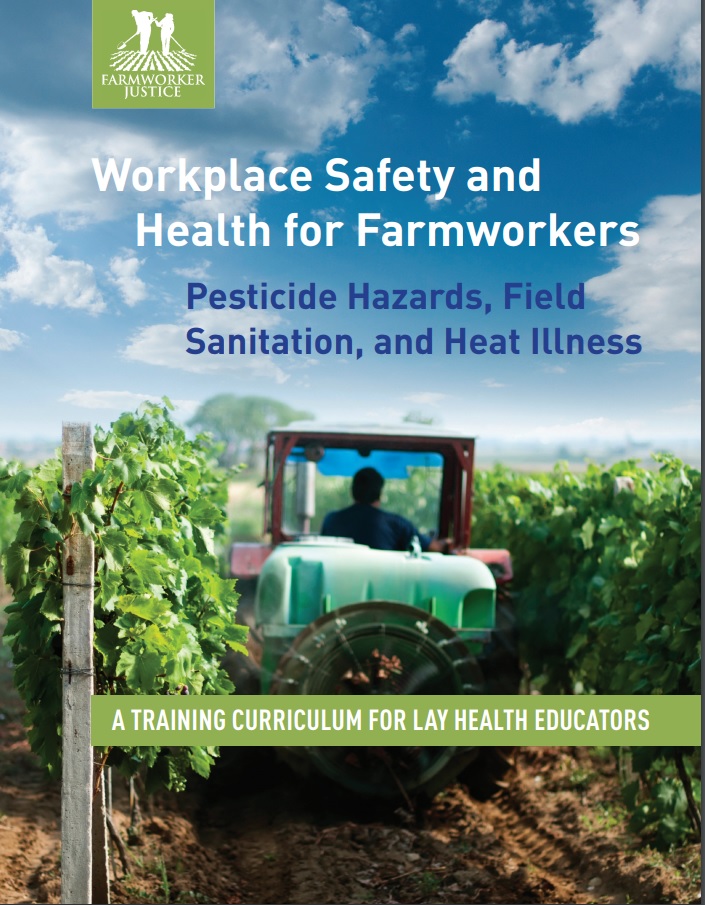
FJ developed a
training module for lay health educators. These materials can be
used to train peer educators who, in turn, can educate farmworkers
and their families on how to reduce their risk of pesticide exposure
and pesticide-related illness. For more information or to download
these materials, visit our
Environmental Health page.
In 1998, FJ Deputy
Director Shelley Davis co-authored the report,
Indifference to
Safety: Florida’s Investigation into Pesticide Poisoning of
Farmworkers. Indifference to Safety reviews the
State of Florida's investigation into 46 complaints of farmworker
pesticide poisoning from January 1992 to mid-May 1997. It examines
the thoroughness of the Florida Department of Agriculture and
Consumer Services' (FDACS) investigation into medical records;
witness testimony and other evidence; FDACS' conclusions drawn from
the evidence; and effectiveness of FDACS' final action to ensure
compliance with the protections provided in the Worker Protection
Standard. The State's handling of pesticide poisoning complaints
revealed a pattern of indifference to its obligation to protect the
safety and health of Florida's farmworkers.
Read our
Farmworker Pesticide Policy Brief from October 2004.
|